
FAQs for Smart D8 Pilot Call 2026
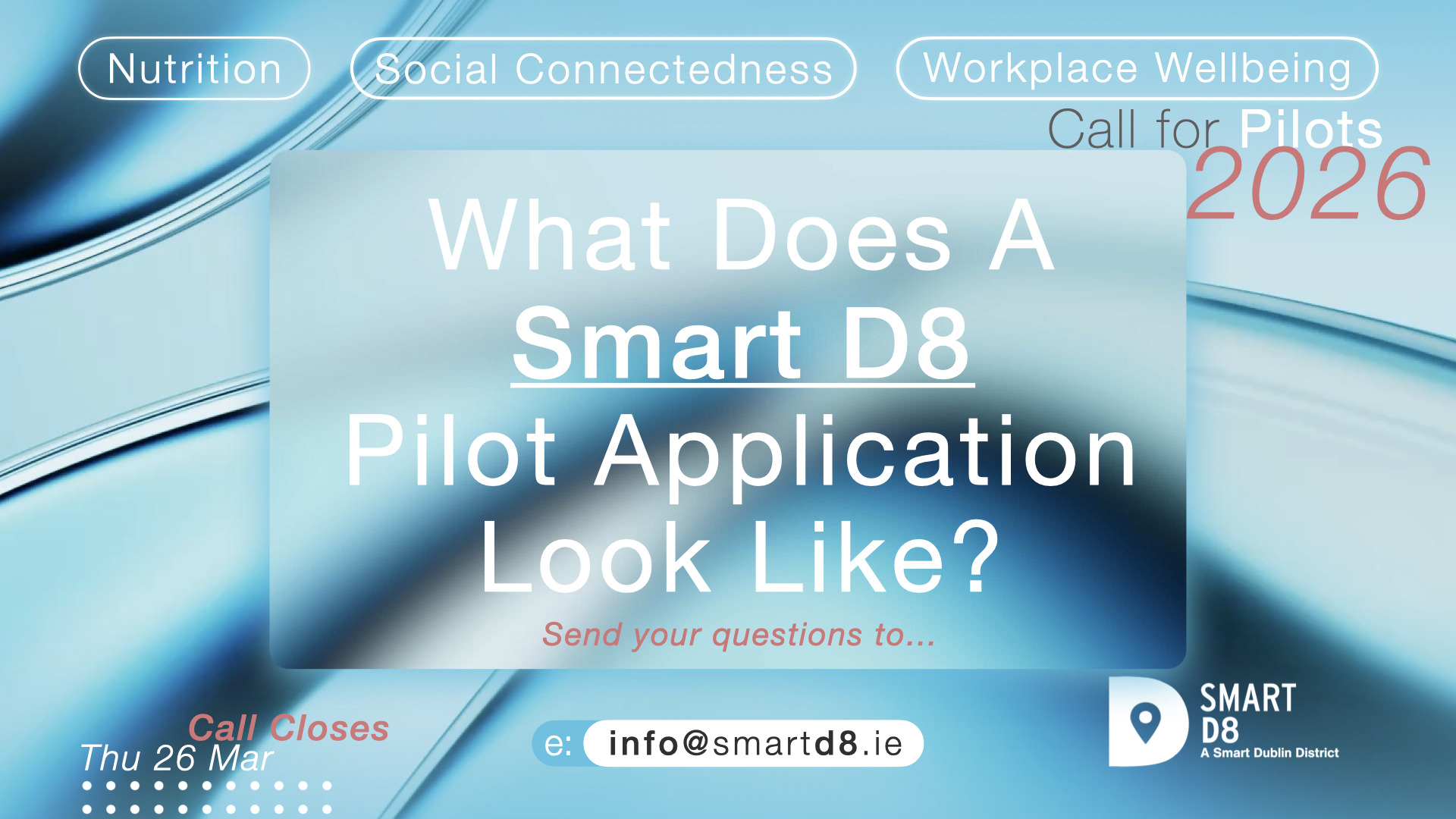
The Smart D8 2026 Pilot Call is now live, inviting innovators from all sectors to pilot projects that can demonstrate population health and wellbeing impacts in real-world environments. Since its inception in 2021, Smart D8 has successfully supported innovators with 19 impactful and innovative pilot projects delivered.
To support prospective applicants, we have released an updated FAQ section to help you navigate the application process. From eligibility criteria and funding details to project expectations and application tips, these FAQs will ensure you have all the information you need to submit a strong proposal.
Submit Your Application
The Smart D8 Pilot Call 2026 is open for submissions until Thursday, March 26th, 2026, at 11 PM (GMT). Up to three pilot proposals will be selected for delivery in 2026, to have the opportunity to trial their innovation in and with a general population to measure their health impacts, gain real-world deployment experience in a real-world setting, and achieve end-user feedback for market-validation of their innovation to scale. Chosen pilots are eligible to receive up to €10,000 in funding to support their delivery as part of their market-validation.
We encourage all applicants to review the FAQs, and visit our website links below for more details on how to apply.
🌍 Read the Press Release: smartd8.ie/opens-doors-to-innovators-2026
🎯 Review the Eligibility Criteria: smartd8.ie/call-for-pilots-2026
💡 Read the FAQs at the Bottom of this Page
✅ Apply Now: tinyurl.com/SmartD8-Apply-Pilots-2026
Applications are made through the application form (linked above) — and the call itself is focused on three key themes: Nutrition; Social Connectedness; and Workplace Wellbeing. Applicants can apply for more than one theme. If your institution cannot access Google Forms via a Google account, you can access the Pilot Application Template, with email submission instructions, here.
Smart D8 is seeking the next generation of population health and wellbeing innovations; to connect them with real people, demonstrate them in real-world environments, and measure their population-scale impacts and outcomes. If you have a health and wellbeing innovation that is near to market and want to achieve market-validation of your research, enterprise, or initiative, improve citizens’ access to health and wellbeing solutions, and jointly measure its impact on population health in the real world — the Smart D8 pilot call 2026 is now open, and ready for your application.
Frequently Asked Questions (FAQs)
-
1. What are the focus areas for the Smart D8 2026 Pilot Call?
The Smart D8 2026 Pilot Call is focused on three key themes:
✅ Nutrition
✅ Social Connectedness
✅ Workplace Wellbeing
This call, while broad in its chosen themes, has very specific eligibility criteria, which is also available with examples here.
-
2. What are the benefits of doing a Smart D8 Pilot?
Selected pilots will have the opportunity to market-validate their innovation in a general population with real people, achieve end-user feedback while demonstrating measurable local health and wellbeing impacts, and gain real-world deployment experience in a real-world environment/setting.
-
3. Is there a specific cohort that my population health innovation should engage?
Smart D8 prioritises innovations that can engage the general population of Dublin 8. As a population health demonstrator, it seeks innovations that engage a general population to demonstrate population-scale impacts and outcomes.
-
4. Does the pilot have to engage Dublin 8?
Yes. Smart D8 is focused on the 45,000 target population of the Dublin 8 region. Applicants must demonstrate a clear engagement plan within the Dublin 8 locality for the duration of the pilot as part of their application, and enabled by collaboration with Smart D8 partners and networks. The area provides a wide and diverse population group across age, gender, educational attainment, access to public and private services, etc. – statistically representative of larger populations; enabling innovations and their health/wellbeing impacts to scale.
-
5. Who are the partners involved in the Smart D8 consortium initiative?
In 2020 Smart D8 purposefully established a unique range and diversity of partners in the consortium. Starting with healthcare providers, the consortium also has representation from municipal, governmental, enterprise, academic and creative stakeholders. The consortium represents a broad perspective on how people live and work, how they access services, travel, and consume public and private facilities and services.
Smart D8 is led by The Digital Hub Development Agency, Dublin City Council, St. James’s Hospital and Smart Dublin. They are joined by Tyndall National Institute, St Patrick’s Mental Health Services, Trinity College Dublin, Trinity Translational Medicine Institute, National College of Art & Design, the Guinness Enterprise Centre, Health Innovation Hub Ireland and the HSE in this unique collaborative initiative.
-
6. How long do pilot projects run, and who manages them?
Pilots should be ready to deploy with end-users in a general population and should be in a position to measure impacts within a maximum six-month timeframe. Selected pilots must self-manage their project’s implementation, stakeholder engagement, and impact measurement. Smart D8 supports through funding, marketing and promotion, and any additional championing partners to help facilitate access to end-users and guidance on their development.
-
7. What kind of impact is expected from these pilots?
The Smart D8 2026 Pilot Call prioritises innovations that can demonstrate engagement with higher numbers of citizens for population-scale impacts and outcomes. Projects should aim for meaningful engagement and measurable impact in Dublin 8 with an ability to scale.
-
8. How do I know what the real-world community setting you’re referring to is, and what their main challenges are so I can address them in my proposal?
Smart D8 can provide links to relevant surveys or reports, such as: Smart D8 community survey from 2020, South Inner City Community Development Association (SICCDA; now ‘The Liberties Community Project’), or Sláintecare Healthy Communities. Additionally, Smart D8 has connections with 34 organisations (e.g. Foróige, The Liberties Community Project), 18 schools (e.g. St. Brigid’s, St. Enda’s), and 3 colleges/adult education services (e.g. Inchicore College of Further Education) in Dublin 8 to support pilots’ meaningful citizen engagement in the Dublin 8 catchment.
-
9. By ‘health’, do you mean ‘healthcare’?
Smart D8 is developing a broad approach to population health and wellbeing, which encompasses illness prevention as well as treatment in the community. It operates at the ‘interface’ of healthcare by engaging citizens in the wider general population of Dublin 8. Smart D8 is inspired by ‘blue zones’ research – and seeks to demonstrate and validate population health impacts for environmental and behavioural change at community scale (preventative). Smart D8 therefore seeks population health innovations in the broadest sense including, but not limited to: habits; lifestyles; behaviours, environments, nutrition; education; movement; mental wellbeing; etc.
-
10. Can international applicants apply, or is the open call limited to Ireland-based entities?
The Smart D8 Pilot Call focuses on solutions that can be trialed within the Dublin 8 area. While international organisations can apply, they must demonstrate a clear engagement plan within the Dublin 8 locality, and can be enabled by collaboration with Smart D8 partners.
-
11. Can I apply as an individual?
Pilot applicants can be either an individual or a team. However, pilot applications still require an organisation to administer your pilot delivery, so that organisational agreements can be made with Smart D8, a Data Protection Impact Assessment (DPIA) can be enabled, and to receive funding for your pilot.
-
12. Do proposals need to emphasise technology?
The pilot call is challenge-based, not technology led. While proposals may include a technology component, the emphasis of a Smart D8 pilot is on innovative content and technologies that are ready to engage citizens, in a general population (non-clinical), and demonstrate measurable impacts on population health and wellbeing in real-world settings. Innovations that can demonstrate engagement with higher numbers of citizens (‘population’ health) will be prioritised for population-scale impacts and outcomes.
-
13. Will Smart D8 develop the technology for us?
No. Smart D8 is a matchmaker, to connect innovations ready for deployment with end-users in real-world environments and measure their health impacts. Smart D8 does not develop technology for pilots, and cannot matchmake innovations with end-users that are not ready for end-user engagement.
-
14. Do projects need to be at a specific stage of development (e.g. prototype vs. fully developed solution)?
Projects should be at a stage where they are ready for real-world testing with end-users. While early-stage pilots and prototypes are welcome, innovations must be developed enough to conduct meaningful engagement and evaluation with citizens from the pilot start, and within the pilot timeframe (up to a maximum of 6 months), and demonstrate measurable impacts on social and economic determinants of health.
-
15. Can a single organisation submit multiple applications for different projects?
Yes, organisations may submit more than one application for more than one strand/theme. However, each eligible application will be evaluated separately, and preference may be given to diverse projects that align best with the current themes.
-
16. Are there any considerations for the types of innovations that can be piloted?
Project-specific considerations (e.g. regulatory approval) are on a project-by-project basis, and the responsibility of the applicant/pilot owner. Approvals necessary for any applicant’s pilot delivery must already be in place at the time of submission. Successful applicants will be expected to complete a Data Protection Impact Assessment (DPIA) form as part of their pilot delivery.
-
17. Does Smart D8 take an equity in my piloted innovation?
Smart D8 does not take equity in pilot projects, and Intellectual property (IP) is retained by the pilot owner/s. Smart D8 seeks to support their citizen engagement, address unmet community-identified needs, and market-validate their population health impacts in a real-world setting with an ability to scale.
-
18. Is there funding available?
Selected pilots are eligible to receive funding support of up to €10,000 incl. VAT to support their delivery as part of their market-validation.
-
19. Is co-funding required, or can projects be fully supported by Smart D8?
Co-funding is not compulsory for project proposals. While successful applicants are eligible for Smart D8 pilot resourcing of up to €10,000 incl. VAT, any other resources necessary for pilot delivery must already be in place at the time of submission.
-
20. Is funding the main purpose of the Smart D8 Pilot Call?
No. Smart D8 is a population health demonstrator; to connect innovative content and technologies with an ability to scale, with citizens and, together, demonstrate their measurable impacts on population health. While some funding is available to support pilots during their pilot timeline, the main purpose of the Smart D8 pilot call, from an applicant’s perspective, should be to achieve market-validation for their innovation with a general population and in a real-world environment — to scale their innovation and population health and wellbeing impacts with it.
-
21. What is the role of blue zones in the 2026 Call?
Smart D8 is inspired by blue zones — geographic regions known for exceptional longevity and wellbeing. Whether related to habits, lifestyles, or individual and community practices, Smart D8 welcomes applications that speak to the health and wellbeing of an individual living in a community with the possibility to scale to a region, nationally and ultimately internationally.
-
22. Will Smart D8 measure the health impacts for our project?
While Smart D8 can input on pilot development and impact measures, successful applicants are expected to measure their health impacts for their pilot and have a clear outline of success criteria at the time their application is submitted.
-
23. I want to work with Smart D8 partners. Can this be done after I apply?
As a consortium initiative, Smart D8 is a partnership of 12 partner organisations. While the Smart D8 partnership may champion pilots to help facilitate their access to end-users and input on their development, key collaborations necessary for their pilot delivery, or specific settings critical for their implementation, must already be in place at the time of submission. Individual organisations can be contacted by the applicant directly in advance of applying.
-
24. Can Smart D8 procure services on behalf of my pilot?
Selected pilots are eligible to receive up to €10,000 (incl. VAT if applicable). While Smart D8 may be able to support through in-kind expertise or venues for some pilot activities, it does not procure services on behalf of the pilot. Pilot applicants must use the pilot funding to resource their pilot delivery and any associated services or expenses.
-
25. My institution requires ethics approval for my pilot. Can Smart D8 help me with this?
Any approvals required by applicants for their pilot is the responsibility of the applicant. Smart D8 does not do this on applicants’ behalf for their application, and any partnerships, resources or approvals necessary for pilot delivery must be in place at the time of the application submission.
-
26. I am awaiting ethics approval for a research part of my project proposal. Can I apply?
Any resources, collaborations or approvals necessary for pilot applicants to deliver their project must already be in place at the time of submission.
-
27. Are there any surveys or reports available relevant to the Dublin 8 area?
Yes. Smart D8 can provide links to relevant surveys or reports, such as: results from the Smart D8 community survey in 2020, as well as others such as South Inner City Community Development Association (SICCDA; now known as ‘The Liberties Community Project’), or Sláintecare Healthy Communities.
-
28. What are the eligibility criteria?
The eligibility criteria are available on the Smart D8 website, at: www.smartd8.ie
-
29. When is the deadline?
The Smart D8 Pilot Call for 2026 is open until Thu 26th March at 23:00 local time (GMT).
-
30. If I have a question related to the Smart D8 Pilot Call, can I ask Smart D8?
Yes. Questions can be sent to <info@smartd8.ie> in time for the application deadline, and as many questions will be responded to as possible.
-
31. Can I get feedback on my application after I submit it?
Due to the high volume of applications received, Smart D8 does not commit to individualised feedback for unsuccessful applicants.