
Smart D8 Call for Pilots 2026 (Call Is Now Closed)
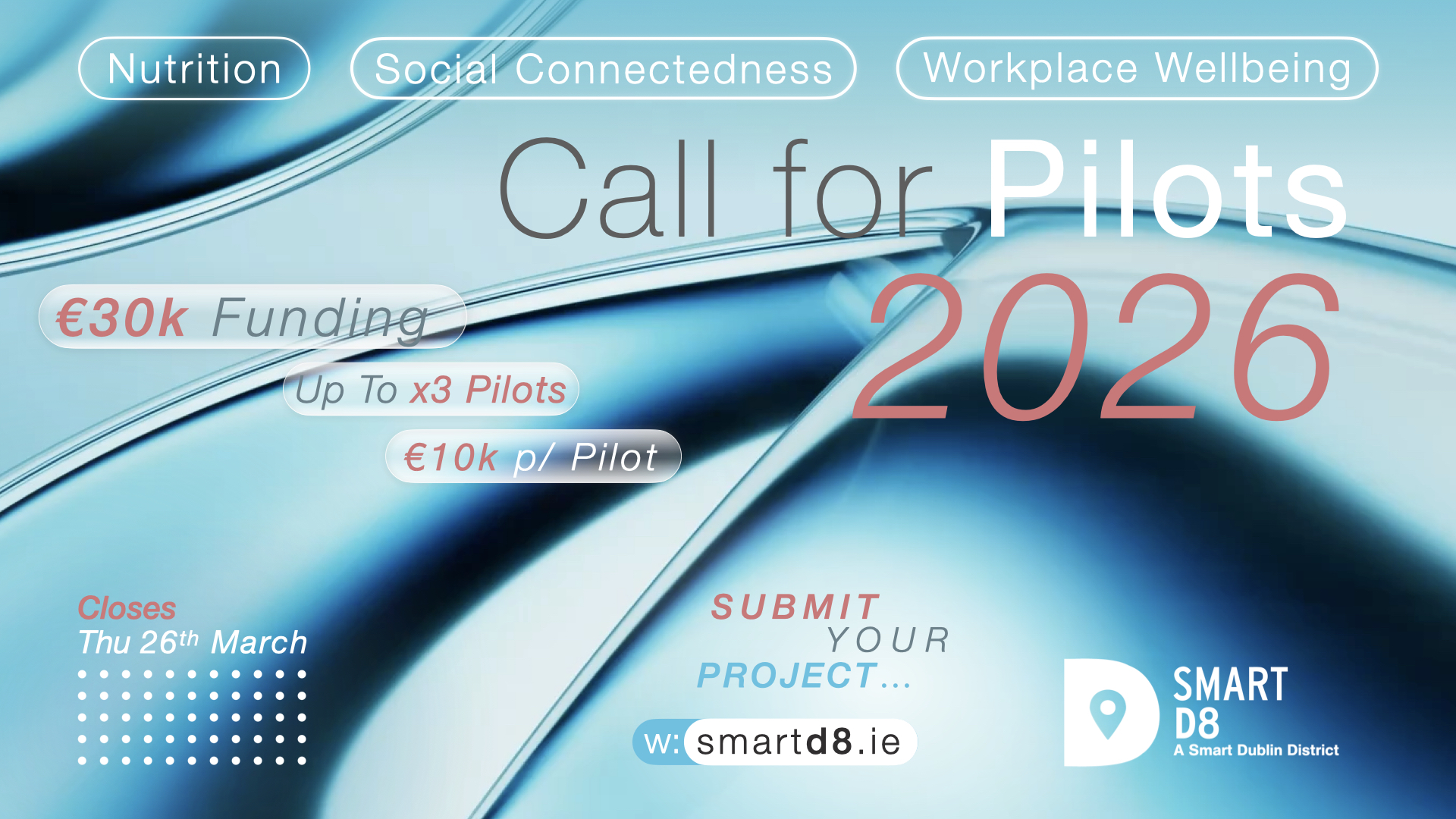
Following five years of success in engaging Enterprise, Academia and a range of relevant stakeholders, the Smart D8 initiative has delivered 19 impactful and scalable pilots. In 2026, this engagement will continue with a sixth open call for pilots.
Continuing to focus on the measured health and wellbeing needs of the 45,000-strong diverse Dublin 8 population, this call will focus on three themes, namely:
- Nutrition,
- Social Connectedness
- Workplace Wellbeing
Smart D8 seeks to support the development of impactful and sustainable pilots that involve enterprise, academic and other relevant public and private stakeholders with the potential to scale. The pilot proposals should be ready to deploy with end-users in a general population and should be in a position to measure impacts within a six-month timeframe. Up to three pilots will be chosen to market-validate their innovation in a general population, and measure its impacts. This also includes individual project resourcing of up to €10,000 including VAT as part of their market-validation with citizens in real-world environments to scale.
To apply, please submit your proposal here: https://tinyurl.com/SmartD8-Apply-Pilots-2026 by Thursday, 26th March 2026 at 23:00 (GMT)
Smart D8 Pilot Call Themes
Some examples of the types of pilots which would be relevant to the Dublin 8 population are given here for illustrative purposes. Smart D8 takes a very broad perspective on population health and wellbeing. The call welcomes proposals focused on approaches to illness prevention, together with support in the community. It includes innovation in the delivery of health and wellbeing in the following application areas.
Nutrition
Organisational or individual service innovations for nutritional resilience – e.g.:
- Whole food, plant-based or Mediterranean diet adoption in community settings
- Food access initiatives for food security and nutritional equity, chronic disease self-management or illness prevention
- Metabolic biomarkers for personalised interventions and behavioural change, such as through nutritional literacy, cooking skills or circadian rhythms
- Education and skills initiatives linking food to mental health
- Local food networks, food labelling transparency, or supply chain and consumption mapping
- Place-based food environment interventions that address proximity to fast food, healthy food option availability, and role of local retailers, schools, workplaces or institutions
- Food labelling, tracing technologies and content
- Meal preparation technologies and content
- Food retail technologies and content
Social Connectedness
- Product or service innovations that can foster measurable neighbourhood-level social capital and informal support networks that reduce loneliness
- Strengthening existing social infrastructure and activation of underused spaces
- Novel digital interventions that incentivise use of community gathering spaces and ‘third places’ (e.g. cafes, libraries, parks, community centres) for social interaction and belonging
- Social prescribing initiatives or solutions that improve connections between individuals and with community activities for healthy habits and lifestyles
- Digital social infrastructure solutions to improve personalised approaches to healthy ageing, or facilitate meaningful intergenerational relationships within Dublin 8
- Community/ group technology and content digital services
- Intergenerational or cross-cultural initiatives that reflect the diversity of the Dublin 8 population
- Education and awareness content
Workplace Wellbeing
- Psychosocial interventions such as stress reduction, mindfulness and cognitive-behavioural approaches to manage burnout and improve mental health resilience
- Wellbeing interventions that can be co-designed with workers and employers (addressing wellbeing as not solely individual resilience)
- Individual or organisational physical activity initiatives integrated into the workplace, such as active commuting, on-site activities or incentive programs
- Early-intervention screening for stress-related biomarkers, cortisol sensors, immune system resilience or mental wellbeing pathways
- Wellbeing activities that address the diverse nature of work in Dublin 8 such as shift work, frontline workers, and small enterprises, addressing workplace wellbeing outside of corporate settings
- Digital solutions for healthy habits and lifestyles as related to living/working environments or work-life balance
- Programs that empower local workers to take an active role in shaping health-conscious work environments
- Metabolic health supports or interventions for daily lifestyles and behavioural change
- Personalised technology and content digital services
- Education and awareness content
Who Should Apply
The pilot call is open to all Enterprise, Academic Institutions, Public and Private sector organisations, who:
- Offer innovative and scalable solutions (products, services, content or devices).
- Provides new practices/solutions/perspectives that address an unmet need in the community.
- Have a solution that is ready for end-user deployment in a general population, and a pilot timeline within six months.
- Can be enabled by co-creation and collaboration with the Smart D8 partners and beyond.
Why Apply?
- Opportunity to market-validate your innovation by piloting it in a real-world community setting; demonstrating its impact and scalability with a general population.
- Access to a unique collaborative ecosystem with established clinical, academic, public and private sector engagement.
- Funding support available for selected pilots.
- Programme management support.
- Marketing and promotion support.
- Access to free workspace in Dublin 8 during the pilot period.
Application Process and Timelines
- Applicants must submit a completed application form through the Smart D8 website here. Applicants can apply for more than one theme. If your institution cannot access Google Forms via a Google account, you can access the Pilot Application Template, with email submission instructions, here.
- Call opens: Thursday, 26th February 2026
- Call closes: Thursday, 26th March 2026 at 23:00 (GMT)
- Evaluation of proposals:
Your submission will be reviewed by an expert panel drawn from the Smart D8 partners. A shortlist of applicants will be selected and will be asked to make a presentation to the evaluation panel. An update on the call outcome will be provided to all applicants at the end of the review process, anticipated by end of May 2026. - Projects to start: June 2026
- Projects to present (interim) results: October 2026
- Projects to finish by: December 2026 (maximum 6-month timeframe)
Eligibility, Evaluation & Selection Criteria
Pilot applications will be evaluated based on the following criteria:
- Impacts at Scale
Smart D8 wants to back scalable projects which can produce and measure clear impacts on the health and wellbeing of a local population. Applications will be studied on the basis of the ambitions for scale during and after the pilot timeline and how this will be achieved, as well as integration with existing services. Innovations that can demonstrate engagement with higher numbers of citizens will be prioritised for population-scale impacts and outcomes. Additional benefit if pilots leverage existing community assets (e.g. community centres, libraries, parks, local employers, schools). - Innovativeness
A level of innovation in terms of product/service will be required that addresses an unmet or underserved need. Innovation in the incremental or disruptive approach taken to advance the pilot with end-users as it relates to health habits and social norms will also be evaluated; as a key determinant of successful health outcomes. - Team & Resources
The Smart D8 evaluation panel will consider what resources and people are being committed to the pilot and what the ask is in terms of people and resources from Smart D8, including the competence of team members for their pilot project delivery. Explicit communication of resource contribution (including budget) is also required, such as what resources are provided versus those requested of Smart D8. - User-Centric
The evaluation team will look for proposals that are end-user focused. The measures of response to the needs of the community or service users for health and wellbeing impacts of the population of D8 will be scored. Shortlisted pilots are expected to consider a structured plan for community feedback and reflection during and after the pilot phase, ensuring learning can be shared with residents and local stakeholders. - Alignment with the objectives of the Smart D8 project.
Smart D8 takes a very broad perspective on population health and wellbeing. It has built direct connections with citizens in a wide and diverse population. Smart D8 is inspired by the concept of blue zones – areas where people live the longest. Smart D8 offers a template for replicating and scaling elements of population health innovation and impact on a wide range of social and economic determinants. Pilots will be evaluated against these objectives as they relate to the Smart D8 programme and involvement of Smart D8 partners.
About Smart D8
‘Smart D8’ is a real-world population health demonstrator providing opportunities for indigenous and international innovators to investigate how smart technology and innovative approaches can improve health and wellbeing with an urban population.
Since October 2020, Smart D8 has brought together innovators and the Dublin 8 community with a diverse range of entrepreneurs, academics, government, healthcare providers and public bodies in a partnership model to demonstrate population health and wellbeing solutions to scale.
Smart D8 is led by The Digital Hub, Dublin City Council, St. James’s Hospital and Smart Dublin. They are joined by Tyndall National Institute, St Patrick’s Mental Health Services, Trinity College Dublin, Trinity Translational Medicine Institute, National College of Art & Design, the Guinness Enterprise Centre, Health Innovation Hub Ireland and the HSE in this unique collaborative initiative.
Smart D8 is focused on finding innovative solutions to improve the health and wellbeing of nearly 45,000 people living in the Dublin 8 region of Ireland’s capital city. Through funded pilot calls and partnerships, Smart D8 facilitates the design, testing and development of future products and services, showcasing their potential to positively impact people’s lives nationally and internationally.
The positive impact of Smart D8 is evident through its enabling of successful pilot projects demonstrated with the local Dublin 8 community. The initiative has supported a total of 19 pilots to date, including Menopause and the City, a menopause education initiative which empowered over 1,500 citizens to manage their symptoms; MoveAhead, which pioneered a motion analytics technology to improve children’s movement skills and enhanced the skills of more than 500 Dublin 8 schoolchildren; and D8 Astro Football, which registered 161 participants through weekly ‘pick-up’ football games and a Social Return on Investment (SROI) framework for improved physical, mental, and social wellbeing.
Smart D8 was shortlisted for HealthTech Innovation of the Year in the Public Sector Digital Transformation Awards 2023, globally recognised as Innovation Finalist at the Smart City Expo World Congress (SCEWC) 2023, awarded for Innovation in Public Administration by the European Public Sector Awards (EPSA) 2023-24, Digital Community finalist at the .ie Digital Town Awards 2024, and most recently overall Citizen Engagement winner with MoveAhead at the Ireland eGovernment Awards 2025.
View the press release here | Apply here by Thursday, 26th March 2026 at 23:00 (GMT)